Tag Archive for: Brightsparkz Tutoring

Why Grade 11 Matters: The Year That Shapes Your Future

It’s tempting to treat Grade 11 as a dress rehearsal – the “real” pressure only kicks in once Matric starts. But that thinking gets the order backwards. By the time Grade 12 begins, much of your future has already started taking shape, and Grade 11 is where that shape gets decided.

Here’s why this specific year carries more weight than it gets credit for.

Grade 11 Marks Are Often Your First Real Currency

If you’re planning to study further, your Grade 11 final results are usually the first marks that count in a formal sense. Most South African universities use them for provisional acceptance – a conditional offer that holds as long as you don’t significantly underperform in Matric.

That provisional offer matters more than it sounds. It’s not just a formality; it’s often your foot in the door while spaces are still being allocated.

The Numbers Make This Impossible to Ignore

South African university admissions are genuinely brutal, and the competition is only intensifying. The University of Johannesburg received over 450,000 applications for its 2026 intake, competing for an undergraduate first-year enrolment of just 11,200 places – a ratio of roughly 40 applicants for every available seat. And that’s just one university.

Other institutions report similarly stretched numbers: UJ alone receives more than 180,000 applications yearly, with fewer than 10% of applicants securing a place, and competition is described as toughest for Law, Health Sciences, and Engineering programmes.

Waiting until Matric to “turn it on” means competing for these same limited spaces against learners who locked in provisional acceptance a year earlier. You’re not just competing on ability at that point – you’re competing on timing, and timing is largely decided in Grade 11.

What Happens If Grade 11 Doesn’t Go Well?

It’s not the end of the road – but it does make things harder. Without a strong provisional offer, you’re more reliant on your Matric results alone carrying the full weight of your application, competing against learners who already have a head start. In practice, this can mean:

  • Deferring entry by a year while spaces are allocated to those with early acceptance
  • Needing to significantly outperform your Grade 11 results just to catch up
  • Missing early bursary and residence application windows, many of which also favour learners with provisional acceptance already secured

None of this is catastrophic, but it’s avoidable friction – and Grade 11 is the year that determines whether you’re navigating around it or not.

It’s Also Where Your Subject Choices Get Locked In

Grade 11 is realistically your last opportunity to reconsider subject choices if something isn’t working. By the time Matric begins, changing direction becomes significantly harder. If you’re even slightly unsure whether your current subjects support what you want to study, this is the year to have that conversation – with a teacher, a tutor, or a subject advisor – not next year.

This is also where a term we’ll unpack properly in a separate guide becomes relevant: your APS score – the points-based system most South African universities use to assess applications. Grade 11 is when it’s worth understanding, in broad terms, how your current marks and subject choices are shaping that score, well before it’s calculated for real in Matric. 

It’s also important to note that different universities manage entry requirements very differently. For example, Wits, UP, and UCT each calculate this completely differently. We break down exactly how in our next guide, so you know which subjects and marks actually matter for the universities you’re targeting.

Grade 11 Is a Practice Run – Use It as One

Beyond the marks themselves, Grade 11 is where you build the habits that carry you through Matric: how you study, how you manage time under pressure, and how you identify and close gaps in your own knowledge before they become a crisis in your final year.

Treat it as a genuine trial run rather than a lower-stakes placeholder, and Matric becomes far more manageable when it arrives.

If You’re Not Where You Want to Be Yet

If your Grade 11 marks aren’t reflecting what you’re capable of, the earlier you address that, the more room you have to fix it before it affects your options. A tutor can help identify exactly where the gaps are and close them before they compound – and can also help you think through whether your current subject choices genuinely support the direction you want to go. Click here to learn more about getting a tutor to help boost your marks. 

Next up: we’ll go deep into APS scores specifically – what they are, how they’re calculated, and how to plan your Grade 11 and 12 years around the score you’ll actually need.
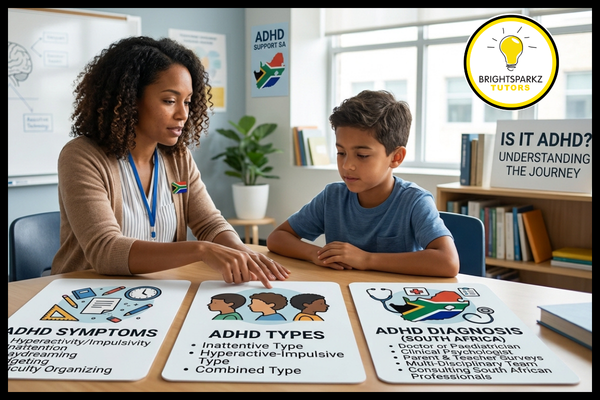
Understanding ADHD: A Parent’s Guide to Symptoms, Types & Diagnosis

If you’re here because something about your child’s behaviour has you wondering – a school report that doesn’t match how bright they seem at home, a teacher’s gentle suggestion, or a nagging feeling that things are harder for them than they should be – this guide is meant to help you make sense of what ADHD actually is, and what the process of finding out looks like.

What Is ADHD?

ADHD stands for Attention Deficit Hyperactivity Disorder. It’s one of the most common barriers to learning among school-aged children, affecting an estimated 5.3% of people worldwide. It’s not a matter of a child being “difficult” or not trying hard enough – it’s a recognised neurodevelopmental condition that affects how the brain manages attention, impulse control, and activity levels.

Because it’s so common, it’s worth every parent, tutor, and educator having a working understanding of what it looks like and how it’s identified – not to self-diagnose, but to know when it’s worth having a proper conversation with a professional.

Understanding ADHD: A Parent's Guide to Symptoms, Types & Diagnosis

What Are the Symptoms of ADHD?

Here’s where it gets genuinely tricky: most young children get distracted, act on impulse, and struggle to sit still at some point. That’s normal childhood behaviour, not ADHD. Symptoms of ADHD usually appear early, often between ages 3 and 6, but because they overlap so heavily with ordinary development, they can be difficult to distinguish – which is exactly why a proper assessment matters rather than a checklist alone.

Symptoms generally fall into three categories:

1. Inattention – a learner may:

  • Be easily distracted, miss details, or frequently switch between tasks
  • Struggle to focus on one thing, especially something not immediately enjoyable
  • Have difficulty organising or completing tasks, or starting something new
  • Lose things needed for tasks (pencils, books, assignments)
  • Seem not to listen when spoken to directly
  • Process information more slowly than peers, or seem to daydream often
  • Struggle to follow multi-step instructions

2. Hyperactivity – a learner may:

  • Fidget, squirm, or struggle to stay seated
  • Talk excessively or seem constantly in motion
  • Have difficulty with quiet, still activities

3. Impulsivity – a learner may:

  • Struggle to wait their turn
  • Blurt out comments or act without considering consequences
  • Interrupt conversations or other people’s activities

Most children with ADHD show a mix of all three, though not always in equal measure – which is where the different types come in.

What Are the Different Types of ADHD?

Predominantly Hyperactive-Impulsive

Six or more hyperactivity/impulsivity symptoms present, with fewer inattentive symptoms (though some may still be there).

Predominantly Inattentive

Six or more inattentive symptoms present, with fewer hyperactive/impulsive symptoms. This is the type most likely to be missed. These learners often sit quietly and don’t act out, so they can look like they’re simply “not paying attention” or “a bit of a daydreamer” rather than showing signs of ADHD – and it’s part of why girls, in particular, tend to be diagnosed later than boys. You can read more about ADHD in girls here.

Combined Type

Six or more symptoms in both categories – this is the most common presentation.

Why ADHD Gets Missed

Because inattentive-type ADHD doesn’t come with disruptive behaviour, it’s easy for parents and teachers to overlook. A learner who’s quiet and well-behaved doesn’t tend to raise the same flags as one who’s visibly restless, even if they’re struggling just as much to keep up.

At the same time, hyperactive-impulsive symptoms are sometimes mistaken for a discipline issue rather than a barrier to learning, particularly in younger children where higher activity levels are developmentally normal.

Both patterns mean ADHD can go unrecognised for years, which is why paying attention to persistent patterns – not isolated moments – matters more than any single behaviour.

How Is ADHD Diagnosed?

There’s no single test for ADHD. Instead, diagnosis in South Africa typically involves a registered educational psychologist (or a paediatrician who may refer you to one), who will gather information about your child’s behaviour across different settings and over time.

The process usually involves ruling out other explanations first, such as:

  • Hearing or vision problems
  • Sleep issues or other medical conditions affecting behaviour
  • Anxiety, depression, or other conditions that can mimic ADHD symptoms
  • A recent major life change (a house move, loss in the family, parents’ divorce) that could be causing temporary behavioural shifts


From there, the psychologist will typically look at:

  • Whether behaviours are long-term and extreme, not just occasional
  • Whether they show up more than in peers of the same age
  • Whether they appear across multiple settings – home, school, social situations – rather than just one

This is usually gathered through observation, questionnaires completed by parents and teachers, and sometimes cognitive or academic assessments to check whether a learning difficulty is also present.

What Happens After a Diagnosis?

A diagnosis isn’t an endpoint – it’s the start of knowing what kind of support will actually help. Depending on your child’s needs, that might include:

  • Tailored academic support. One-on-one tutoring, paced and structured around how your child’s brain works best, rather than a one-size-fits-all classroom approach.
  • Exam accommodations. Many learners with ADHD qualify for support such as extra time or a prompter during assessments – worth discussing with your school. You can also find more information on our quick blog here.
  • A clearer picture of exam-time challenges specifically. Some learners manage well day-to-day but really struggle when assessment pressure hits – see our guide on why ADHD symptoms often intensify at exam time.

If you’re trying to work out whether what you’re seeing at home fits this picture, or you’ve already got a diagnosis and are wondering what support looks like in practice, BrightSparkz’s neurodivergent tutoring approach is a good next step to explore.

Why Does My Child’s ADHD Seem to Get Worse at Exam Time?

If your child manages reasonably well through the term – keeping up in class, getting homework done, coping day to day – and then everything seems to fall apart the moment exams or big assessments arrive, you’re probably not just imagining it. This is one of the most common patterns we see, and there’s a real explanation behind it.

ADHD during exam times

It’s Not That ADHD “Gets Worse” – It’s That Exams Demand Exactly What’s Hardest

ADHD doesn’t intensify overnight. What changes is the demand being placed on the parts of the brain ADHD affects most: planning, time management, working memory, and sustained focus under pressure – collectively known as executive function.

Day-to-day schoolwork is broken into smaller, structured chunks with regular check-ins from a teacher. Exams remove almost all of that structure at once: long stretches of independent, self-paced work, often across multiple subjects in a short window, with real stakes attached. For a learner whose executive function is already working harder than most just to keep up, that’s the exact combination that tends to expose the strain.

Why This Often Shows Up Specifically at Report Card and Prelim Time

A few patterns show up again and again around Term 2 report cards and Matric prelims in particular:

  • The gap between “knowing it” and “showing it” widens. Your child may understand the content perfectly when you go through it together, but freeze, blank, or run out of time the moment they’re sitting the actual assessment.
  • Studying itself becomes the obstacle. Revision requires self-directed planning – deciding what to study, when, and for how long – which is precisely the executive function skill ADHD makes hardest. It’s not unwillingness; it’s a genuine difficulty getting started and staying on track without external structure.
  • Time pressure amplifies everything. A learner who manages time reasonably well with support may completely lose track of pacing once they’re on their own in an exam venue.
  • Stress compounds the difficulty. Exam pressure adds an emotional-regulation load on top of an already-stretched attention system, which is part of why a capable learner can seem to “shut down” under pressure in a way that doesn’t match how they perform normally.

Is It ADHD, or Is It Just Exam Stress?

This is a fair question, and the honest answer is: it can be both, and they can worsen each other. Ordinary exam nerves are common in almost every learner. What tends to point specifically toward ADHD-related strain, rather than general stress, is a pattern where:

  • The struggle is disproportionate to how well your child understands the actual content
  • It happens consistently across assessments and subjects, not just one stressful test
  • It’s paired with the same difficulties you may see at other times – losing track of tasks, poor time estimation, trouble starting – just more visible under pressure

If you’re not sure which is driving what you’re seeing, that’s a reasonable thing to raise directly with a psychologist or your child’s tutor, rather than trying to work it out alone.

What Actually Helps at This Stage

The good news is that this pattern, while frustrating, is well understood – and there’s a lot that can help:

  • Structured, one-on-one support that breaks studying into manageable, externally-paced chunks – rather than expecting a learner to self-organise their own revision from scratch.
  • Practising under timed, exam-like conditions in advance, so the pressure itself becomes more familiar rather than something they’re facing cold for the first time.
  • Checking whether exam accommodations are appropriate – many learners with ADHD qualify for support like extra time or a prompter, which can meaningfully change how an exam actually plays out for them. See our guide on accommodations and concessions if this is new territory for you.
  • Tutoring specifically paced around how your child’s brain works, rather than a generic study plan. BrightSparkz’s neurodivergent tutoring approach is built around exactly this kind of individualised pacing.

You’re Not Overreacting

If report card season or prelims have you noticing a real dip that doesn’t match how capable you know your child to be, that instinct is worth listening to. This is one of the most common reasons families come to us for support in Term 2 and ahead of Matric finals – and it’s very fixable with the right structure in place.

Get in touch with BrightSparkz Tutors if you’d like help figuring out what kind of support would make the biggest difference for your child right now.

Tutor Of The Month: Christie Munro

BrightSparkz Tutor of the Month

Christie is our February 2018 Tutor of the Month!

Christie matriculated from Rhenish Girls’ High in 2015 with fantastic results – 7 distinctions! She is currently completing her BSc majoring in Ocean and Atmosphere Science and Marine Biology at UCT, and has also studied Mandarin for 4 years. She is also a volunteer for the Two Oceans Aquarium in Cape Town. Christie has been tutoring for BrightSparkz since the middle of 2016, and has taken on several clients for us, tutoring everything from Maths and Life Science to EMS! Our team loves Christie because of her quick, cheerful responses and her willingness to take on any client. Her clients love her for her positivity and the amazing effect she has on her learners. She is a sweet, engaging tutor with a real passion for helping others, and we’re so happy to have her as part of our team. 

What some of Christie’s clients have to say about her: 

“ I wish to advise that Christie did a really great job helping Nicola – she has now written both her Matric Maths exams and both seemed to go reasonably well.  I wish you to pass on to Christie our many thanks for her dedication and attention to detail as well as her excellent teaching systems – they all made a huge difference to Nicola.”

Thank you for your dedication and effort as a BrightSparkz Tutor , Christie!

To get your amazing tutor, click here. 

Tutor Of The Month: Tayla Booyse

Tayla Booyse Tutor of the Month

Tayla is our January 2018 Tutor of the Month!

Tayla matriculated from Brescia House in 2013 with outstanding results, including 4 distinctions. She is currently in her 4th year at Wits University, studying Speech Pathology and Audiology and will be doing her community service this year. Tayla has been tutoring for BrightSparkz since 2014 and is one of our trained Afrikaans Boot Camp tutors. She is a reliable, kind, patient and hard-working tutor who has a passion for helping others. She is always willing to help and enjoys going the extra mile for her learners and clients. Over the past year, she has worked with over ten clients (Afrikaans Boot Camp and tutoring clients) and has always received amazing and positive feedback for all her lessons. She is an exceptional tutor and we are so proud and thankful for having her as part of our team.

What some of Tayla’s clients have to say about her: “My son was positive after the session. Tayla seemed very patient with Cameron.”

Thank you for your passion and effort as a BrightSparkz Tutor and Afrikaans Boot Camp trainer, Tayla!

To get your amazing tutor, click here. To find out more about our Afrikaans Boot Camp, click here.

Tutor Of The Month: Rosha Naidoo

Tutor of the Month

Rosha is our December 2017 Tutor of the Month!

Rosha has been a tutor with us since September 2016. She was one of our first Readers & Scribes, and has assisted 6 learners through multiple sets of tests and exams since March this year, and has also tutored two learners. She has completed her Bachelor of Social Science, and two Honors degrees in Social Science, all at UKZN. She is currently completing her Masters degree. She volunteers at various children’s homes and charity events, and enjoys cooking, gardening and writing. Rosha is always willing to help, she is reliable and dedicated. The learners she assists during their exams and tests say she makes them feel comfortable and at ease. She always calls before exams to introduce herself and to check in with the learners she has been assisting. Rosha reads at a steady pace and makes sure the learner doesn’t fall behind.

Thank you for your hard work and the excellent example you’ve set as a concessions facilitator this year, Rosha!

To get your own incredible Reader or Scribe, click here. For your own amazing tutor, click here.

Is It Worth Writing Matric Supplementary Exams?

Details regarding the combined May/June 2026 Amended Senior Certificate (adult Matric) and National Senior Certificate examination will be communicated to candidates in due course. Candidates are encouraged by the Department of Education to use this additional time to continue with their examination preparations. Find out more here


*Adults that qualify to write the 2026 Senior Certificate examination must register for the examination from 01 October 2025 until roughly 06 February 2026. Registration can be done online or at any education district office.*

Should you write supplementary exams?

If you have written your Matric examinations and your results were disappointing, you have an option to improve your results.  Perhaps you passed Grade 12 but failed to get the results you need for that university course you want? Maybe you failed Matric and won’t get a Matric certificate? And now you’re concerned about not being able to get a job without one?  

Matric rewrite supplementary exam

Whatever your reasons may be, writing supplementary Matric exams is an option to consider. There are major benefits to doing so, even though the thought of putting your life back a year is daunting. Yes, your friends may be moving on to greater things like tertiary study, working, or taking a gap year while you are stuck doing Matric work again! And yes, you can’t bear the thought of doing the same schoolwork again when you could not wait to put it behind you. Yes, you are disappointed at this roadblock in your life which right now feels like a devastating blow!

It’s tough, we know

You have taken a serious knock to your self-confidence and you’re not sure which direction to follow. If you passed overall, should you give up your dreams of getting a university entrance or studying a specific field because your marks were not good enough? Should you settle for something else? If you failed your Matric exams, is it worth it to rewrite and get a Matric certificate? Should you suffer through the pain of trying to improve your Maths and Science marks? Will it really make a difference? Perhaps you were not planning to study further anyway, so why bother?

Good questions! However, you need to look beyond the here and now for your answers. Why give up your dreams if it is possible to still reach for them (even though it may be a little inconvenient now?). What happens if you settle for something else and you regret it later, or decide after a few years of working that you would like to study again but you don’t have a Matric certificate?

Benefits of having a matric certificate

Having a Matric certificate gives you more options in life in terms of job opportunities, and who doesn’t like having options? You will find it difficult to find employment without Matric and even then, the most menial type of work possible. It may seem unimportant to you now as it is exciting to earn money, especially if you’re not used to having any, but it wears thin quickly if your earning potential never increases and you have to settle for anything you can get.

Although it seems like a big sacrifice to put your life on hold while you write supplementary exams, it is a small price to pay for all the years of a better future which lie ahead. It is worth doing merely to improve your options in life. (Particularly, improving on your Maths and Science marks if you have those as subjects, will allow you almost unlimited options in your study choices).

Matric rewrite supplementary exam

How to succeed in your supplementary exam

You will need to do things differently to ensure a better outcome than the first time you wrote your Grade 12 exams. You will need to be disciplined, to manage your time well, and to set some realistic study goals. Remember that a failed exam does not define you! The power is in your hands.

If you feel like you don’t know how to study correctly, and you suspect that this has adversely affected your marks, try a Study Skills Crash Course. If you did not understand some aspects of the work, you will need to get some help – either enroll at a college which offers matric rewrites, or do it yourself with the help of past papers and a tutor. A highly qualified tutor will be able to offer you academic and emotional support. Your tutor has walked the path ahead of you and knows what it takes to get the Matric results you want!

Give yourself every opportunity for a bright future and consider writing supplementary Matric examinations! Book a tutor to help you now!

Find out if you qualify to write a supplementary exam here. 


Matric Supplementary Exam Enquiry

To book a tutor please complete the form below (hourly rates start at R350/hr* online):

  • This field is for validation purposes and should be left unchanged.
  • Include the subjects which you've registered to re-take.

Why tutoring is the best part-time job

Looking for a part-time job? Be a Tutor!

If you are interested in getting a part-time job, there are so many options available to you – it’s often daunting trying to choose! Part-time jobs may require different skills sets, and range from less skilled jobs (washing dishes or flipping burgers), to the highly-skilled spectrum where formal education and experience is required, like business consulting or coaching.

Tutoring as a part-time job falls under the spectrum of skilled work. You need to be well educated yourself and have achieved good results to be able to help others as an academic tutor. Tutoring offers you many benefits as a part-time job – here are just some of them:

Being a tutor helps you develop your character and life skills

You will learn patience and empathy as a tutor, or develop these traits further. Some learners will grasp concepts more quickly than others, and all learners learn in different ways.

You will also learn or improve on your own time management and goal-setting skills as you assist your learners to do the same.

Tutoring grows your own knowledge base – you learn when teaching others

As much as you are teaching others, you will learn from them. This might not be in an academic sense, but in many other ways. Tutoring will “cement” your own knowledge as you teach key concepts, which may make the experience more enjoyable for you as well.Tutor value best part-time job

Being a tutor allows you to share the knowledge and wisdom you’ve gained so far in life

People who are a few steps behind you on the ladder of life will benefit greatly from the life lessons and academic achievements that you have already passed through. Learners may see you as a mentor and adviser. You can use your own experience to give them tips and advice on studying, managing stress, a study-fun balance and more!

Tutoring allows you to help others and make a difference in their lives

You will gain a great deal of personal satisfaction from being a positive force in the life of a learner and possibly a role model too. When your learner improves their marks, and gains a more positive attitude, you will feel like you’ve achieved something great. You surely have, as the impact you have made affects the academic future and ultimately, the life options of the learner. Make a difference as a tutor part-time job

Being a tutor improves your relationship-building skills and gains you friendships

You will be dealing with a variety of clients and learners, some of whom you may naturally relate to better than others! This will develop your communication and negotiation skills, both of which are important life skills to have.

You may end up having lifelong friends among the clients and learners that you tutor.

Tutoring will give you valuable experience to add to your CV

Being a tutor, like a teacher, is an honorable job which impacts the lives of others. You are required to demonstrate not only academic skills, but also responsibility, reliability, planning and commitment, which are all very valuable skills to potential employers in any field.

You will also be able to get valuable references from your clients if you deliver a great service, as well as from your tutoring company.Improve learners lives tutor part-time job

Being a tutor gives you flexibility

You can choose the days and times that fit into your schedule more so than most other part-time jobs, making this a job that fits into your schedule and doesn’t encroach on your study and leisure time as much as other part-time jobs, like being a waiter or cashier.

Tutor at a great hourly rate

Tutoring is a great way to earn income, at a much higher hourly rate than minimum wage. An hour of tutoring a week will allow you to earn the same amount as several hours’ in another part-time job. If you need a little extra income in your budget, tutoring regularly will give that to you without sacrificing a huge amount of time.


If you want a part-time job, and would love to experience all the benefits of tutoring, apply now to BrightSparkz Tutors and join the team!


Written by: Natalie Wilke, BrightSparkz Staff & Blog Writer

Tutor Of The Month: Marc Kasongo

Marc Kasongo

Marc is our November 2017 Tutor of the Month!

We are proud to announce that Marc Kasongo is our Tutor of the Month for November! Marc is one of our newer tutors who has proven himself as an incredible asset to our team very quickly. He receives excellent feedback from all the clients he works with, and is currently in his 3rd year of a Bachelor of Civil Engineering degree at the University of Johannesburg. Marc is one of our tutors who are able to tutor Maths and the Sciences to Grade 8 – 12 level learners, as these are his specialty subjects. Thank you Marc for your dedication and commitment to our team and to your learners who look up to you!

Marc has the following to say about tutoring:

“I was a scholar at an IEB school where I managed to achieve 72% for Mathematics in Matric, and I would like to help high school learners achieve the same or even higher! I have over 100 hours of tutoring experience and in that time I have learnt to be patient, calm and reliable… The only vision I have for my students is success!”

To get your own amazing tutor, click here.

Why I Love Tutoring

Ever since I can remember, I’ve wanted to be a teacher. I admired my teachers throughout my schooling years; the good and the bad. There is always something you can learn from them, whether that be the content they taught in the classroom or the manner in which they handled themselves in tough or awkward situations. One can teach anywhere – it’s just a matter of creativity. Tutoring is a fantastic way to bring this dream to life.

love tutoring

As a tutor, my job is to help a learner achieve their academic goals and guide them through their academic struggles. It truly is rewarding when you physically get to see how your efforts helped improve a learner’s mark on a test or report. The smile you get to see on your learner’s face as to how proud they are of themselves is really all the matters at the end of the day. I have learnt how to be myself through teaching. I don’t have to always know it all and be the ambassador of the subject. I love teaching because your learners want to feel as if you are both going through this journey together. You are helping them achieve something they want and the journey is much more important than the destination.

Tutoring can be challenging, especially when it comes to motivating your learner. You see the potential they have, and they often hear about the potential they have, but they do not feel as though they’ve got what it takes. Living in such a busy and demanding time can often make us feel the time constraints on everything we do and we expect our learners to get things done and understood as fast as possible. Sometimes it’s okay to take a step back and sit with your learner to reflect on where they are emotionally, mentally and physically. Taking the time to help them stop what they’re doing and to spend a few moments to take a deep breath and talk about where they are in life can take away a tremendous amount of pressure from them. I find this exercise vital as it also gives me an opportunity to strengthen my relationship with my learners. It helps them see I am human just like them and it’s okay to feel overwhelmed. I encourage my learners to take baby steps as they work toward big goals and the proof is in the pudding.

I love tutoring because I am given the opportunity to help children achieve their best and inspire them on a personal and academic level. It excites me to see how energetic a learner becomes as soon as they understand a topic they struggled with. The determination and enthusiasm that stirs within a child is heart-warming. I enjoy getting to know my learners and to learn about life from their perspective. It brings me such a sense of joy to gain insight into their views and opinions about life. I can confidently say that I have learnt as much from my learners as they have learnt from me. That is why I love tutoring. 

You can become a BrightSparkz tutor here.

Written by Neeza Ramiah, BrightSparkz Tutor