Is My Child a Candidate for Accommodations and/or Concessions?
If your child knows the work but seems to fall apart the moment a test or exam starts, you’re not alone – and you’re asking exactly the right question. Many parents don’t realise that struggling under assessment conditions is different from struggling with the actual content. That distinction is often the first clue to what kind of support your child might actually need.
Accommodations and concessions exist to give learners with genuine barriers to learning a fair shot at succeeding academically. But they solve two different problems – and it’s not always obvious which one applies to your child, or whether it’s really a tutor you need instead. Here’s how to start figuring that out.

What’s the Difference Between an Accommodation and a Concession?
This is worth getting right, because the two terms get used loosely but mean different things:
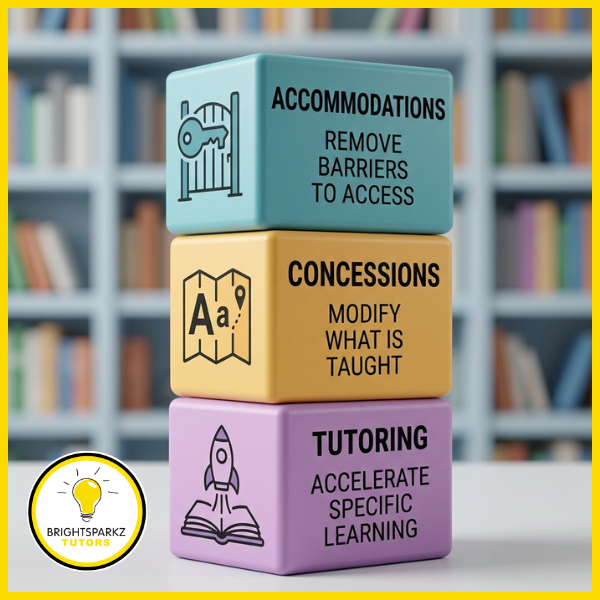
Accommodations change how your child engages with or writes an assessment – not what they’re being assessed on. Extra time, a reader, a scribe, rest breaks, enlarged print, being allowed to type instead of write: all of these adjust the conditions of the exam itself, while the actual content and standard your child is measured against stays the same.
Concessions change what your child is required to study or be assessed on in the first place. Being exempted from a First Additional Language, or granted an exemption from Mathematics and Mathematical Literacy, are concessions – they alter the curriculum or subject requirements, not just the writing conditions.
Put simply: if the support changes how your child sits an exam, it’s an accommodation. If it changes what they’re required to take at all, it’s a concession.
Many learners only ever need accommodations. Some need a concession as well. It depends entirely on the nature of the barrier.
Signs Your Child Might Need Accommodations
A few patterns tend to point toward an accommodation – support that changes exam conditions, not subject requirements:
- They know the work at home but blank out in tests. If your child can explain a concept clearly the night before, but the mark doesn’t reflect that understanding, the gap may be in how the assessment is administered.
- They run out of time, every time. Not occasionally rushing the last question – consistently unable to finish, even on content they understand well.
- Reading or writing itself is the obstacle. If your child can discuss a topic fluently but struggles to get thoughts onto paper, or reading a question is where they stumble, a reader or scribe accommodation may be worth exploring.
- Focus, not knowledge, is the issue. Some learners – often those with ADHD or who are on the autism spectrum – know the content but lose the exam to distraction, hyperfocus, or difficulty pacing themselves.
- There’s a diagnosed or suspected physical or medical barrier. Vision, hearing, mobility, or a condition requiring breaks or medication during a long assessment.
- Anxiety takes over. Some learners have the knowledge and the skills, but the pressure of the assessment itself derails their performance.
- Spelling or handwriting quality is masking what they actually know. If untidy writing or spelling errors seem to be costing marks unrelated to the subject itself, that may be an accommodation issue.
Signs Your Child Might Need a Concession
Concessions are a different question entirely – this is about whether a specific subject or requirement is the barrier, not the exam conditions:
- A specific subject is consistently and disproportionately difficult, in a way that seems tied to a diagnosed difficulty rather than lack of effort or support – for example, a learner with dyscalculia struggling with Mathematics specifically, regardless of how much support is in place elsewhere.
- A language requirement is the primary obstacle, particularly where a First Additional Language is proving to be a barrier unrelated to overall academic ability.
- The issue persists despite accommodations already being in place. If your child already has extra time or a reader and a specific subject is still consistently out of reach, that may point toward a concession conversation rather than a further accommodation.
Is It a Tutor I Need, or Accommodations/Concessions?
This is the question we get asked most often, and it’s a genuinely important one to get right, because these solve different problems.
A tutor helps when the issue is understanding the content. If your child hasn’t fully grasped a topic, is behind on curriculum, or needs to build confidence and skill in a subject, tutoring is the right tool – and often makes a real, measurable difference to marks over a term.
Accommodations help when your child understands the content but can’t reliably demonstrate it under standard exam conditions – because of how they read, write, focus, or manage time. Concessions help when a specific subject or requirement itself is the barrier, regardless of how much support is given.
For some learners, it’s a combination of all three. A learner with dyscalculia, for example, might benefit from Maths tutoring, an accommodation like extra time, and ultimately a concession from the standard Mathematics requirement if the barrier persists. These aren’t competing solutions – they can work together.
If you’re not sure where your child’s situation falls, that uncertainty is itself worth raising with a professional, rather than trying to resolve it alone.
Does It Matter Which School or Exam Body My Child Is Under?
Yes – and this trips a lot of parents up. Accommodations and concessions aren’t governed by one single set of rules. Whether your child is in a CAPS (public school), IEB (private school), or Cambridge/international curriculum changes:
- Who assesses eligibility
- What documentation is required
- How the application is submitted
- How long it takes to get a decision
The good news is you don’t need to become an expert in all of this yourself. Your first move is simply to find out which body governs your child’s assessments. Your school will know – and take it from there.
For the full breakdown of every accommodation and concession type, plus the step-by-step process for each curriculum, see our Ultimate Guide to Concessions and Accommodations.
What Happens If I Think My Child Needs to Apply?
Broadly, the path looks like this regardless of curriculum, and regardless of whether you’re pursuing an accommodation, a concession, or both:
- Start the conversation with your child’s school – their teacher, school counsellor, or head of phase can point you to the right internal process.
- Get a professional assessment, usually from an educational psychologist, if the concern relates to a learning, emotional, or behavioural barrier. Physical or medical barriers usually require a medical report instead.
- Submit the required documentation through your school or governing body, and allow time – this process is rarely instant.
This is a simplified overview on purpose. Every governing body has its own forms, timelines, and specific requirements, and getting those details right matters.
Once Support Is Approved – What Then?
If your child’s approved accommodation doesn’t require another person present – extra time, a separate venue, enlarged print – your school will generally implement this directly.
If your child is approved for an accommodation that requires a facilitator – a reader, scribe, prompter, or similar – the next step is finding the right person for the job. This matters more than it might seem: a facilitator isn’t just administrative support. Rather, they’re someone your child needs to feel comfortable and confident with in a high-pressure moment.
This is where BrightSparkz comes in. We’ve placed concession facilitators for learners for years, across CAPS, IEB, and tertiary institutions. Every facilitator we place is trained, vetted, and backed by a team – so if your regular facilitator can’t make an exam, you’re never left without support. Our experienced team has put together a blog on what facilitators want clients to know, if you’d like to learn more about the nitty-gritty.
Not Sure Where You Stand? Start Here
If you’re still unsure whether your child needs an accommodation, a concession, a tutor, or a conversation with their school first. That’s completely normal – this isn’t always a clear-cut decision. It shouldn’t have to be one you figure out alone.
Get in touch with BrightSparkz Tutors and we’ll help you think through the right next step for your child.


Does applying for a concession help students write overtime during examinations ?
Hi Itumeleng. Yes, extra time in examinations is one of the most common concessions, but is only given to students with barriers to learning who need it.
Do scribes get paid, or is it voluntary?
Hi Louise. All BrightSparkz scribes, as well as readers, prompters, personal assistants and invigilators, do get paid.
Hi
Could you please tell me if concessions such as extra time, spelling flag and a reader are only applicable during exams or are they applicable during tests and other school based assessments too? I was told at my school that the assistance apply during exams only. This does not make sense as the learners have the problem all the time and not only during exams.
Hi Stefanie. The school and district support team will determine what concessions are appropriate – these could be only for exams, for all tests, exams and assessments, or even for in-class support. It depends on the nature of the learning barrier. You can always contact your district education office if you have questions about this process.
Is it true that if a child has an average above 60% the consession falls away. This will affect the child negatively as the won’t reach their full potential.
Hi Johan, this is not true – a concession is not dependent on marks, but may be reevaluated if the school feels your child has moved beyond needing a concession.
My kids have been granted amanuenses by the DBE.
Are these only only applicable to certain exams, or will children be accommodated during tests at the end of Q1 and Q3? Our school only allows amanuenses during the July & Nov exam – but my question is why the DBE does not allow amanuenses for tests or exams (where the school decided to write an exam an not a test series)?
Hi Hein, the specifics will be in the letter from the DBE stating the concession – it might be for all tests and all exams, or only for certain ones. It will also depend on what your school is able to accommodate.
Good day,
How can I help my son with consesions to rewrite his Science and Physics for grade 10 (2024) if they put him through to grade 11 (2025)
I am on the brink of not knowing which way to go. The school is a special school. 2 Boys take exactly same subjects. For my son there was told he have to get his own tutor but the other son a teacher assisted. My son knows exactly what the answers are but doesn’t know how to put it in words. First of all, its a special school as they’ve promised in the beginning special classes and tutors amunuense assistance as per SNA form. He was supposed to be registered for science and Physics this year whereas the school never did and holding him back by pushing him in a direction like Tourism whereby he want to be a Mechanic. They just wangle everything so the school have 💯 passrate. Not worried about the son’s future. Whom can I contact at the dept of education as I receive no joy from the school. Not at all, meeting by meeting attending And they just talk about how lazy he is but infact he is super clever. PLEASE HELP. MY SON IS EMOTIONALLY BROKEN BY THE SCHOOL AND THE DAD, Because the dad is scared he have to pay for another year.
Please PLEASE HEAR MY CRY.
Desperate mom
Hi Carmen,
Thanks for reaching out! We are so sorry to hear about all that you have been struggling with. It’s recommended that you get in touch with the Education Department relevant to your province, rather than the national body. Engaging a lawyer (or legal clinic) to outline your available options might be another valuable route you could consider.
If you need assistance in terms of getting a tutor or a facilitator for concessions, please don’t hesitate to reach out to us here at BrightSparkz Tutors on tutors@brightsparkz.co.za
Wishing you the best of luck!
Should we write in a term report comment that the learner was supported by the concession in his/her exams and congratulate him/her for passing?
Hi Rirhandzu,
It is most likely not necessary to note it in the report, unless your school’s policies require it :) However, a nice congratulatory message is always welcome! It’s special to let kids know that you’re proud they’ve triumphed over adversity. Hope this helps!