Understanding ADHD: A Parent’s Guide to Symptoms, Types & Diagnosis
If you’re here because something about your child’s behaviour has you wondering – a school report that doesn’t match how bright they seem at home, a teacher’s gentle suggestion, or a nagging feeling that things are harder for them than they should be – this guide is meant to help you make sense of what ADHD actually is, and what the process of finding out looks like.
What Is ADHD?
ADHD stands for Attention Deficit Hyperactivity Disorder. It’s one of the most common barriers to learning among school-aged children, affecting an estimated 5.3% of people worldwide. It’s not a matter of a child being “difficult” or not trying hard enough – it’s a recognised neurodevelopmental condition that affects how the brain manages attention, impulse control, and activity levels.
Because it’s so common, it’s worth every parent, tutor, and educator having a working understanding of what it looks like and how it’s identified – not to self-diagnose, but to know when it’s worth having a proper conversation with a professional.
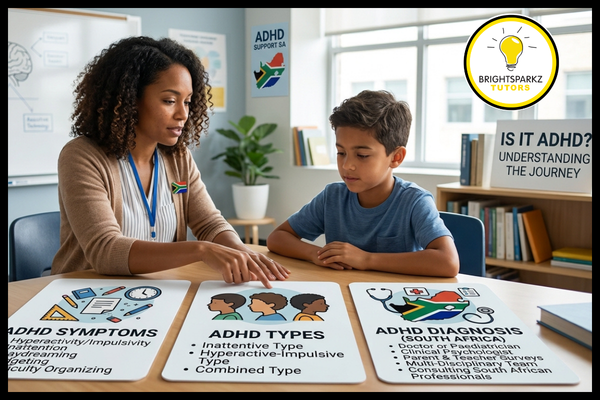
What Are the Symptoms of ADHD?
Here’s where it gets genuinely tricky: most young children get distracted, act on impulse, and struggle to sit still at some point. That’s normal childhood behaviour, not ADHD. Symptoms of ADHD usually appear early, often between ages 3 and 6, but because they overlap so heavily with ordinary development, they can be difficult to distinguish – which is exactly why a proper assessment matters rather than a checklist alone.
Symptoms generally fall into three categories:
1. Inattention – a learner may:
- Be easily distracted, miss details, or frequently switch between tasks
- Struggle to focus on one thing, especially something not immediately enjoyable
- Have difficulty organising or completing tasks, or starting something new
- Lose things needed for tasks (pencils, books, assignments)
- Seem not to listen when spoken to directly
- Process information more slowly than peers, or seem to daydream often
- Struggle to follow multi-step instructions
2. Hyperactivity – a learner may:
- Fidget, squirm, or struggle to stay seated
- Talk excessively or seem constantly in motion
- Have difficulty with quiet, still activities
3. Impulsivity – a learner may:
- Struggle to wait their turn
- Blurt out comments or act without considering consequences
- Interrupt conversations or other people’s activities
Most children with ADHD show a mix of all three, though not always in equal measure – which is where the different types come in.
What Are the Different Types of ADHD?
Predominantly Hyperactive-Impulsive
Six or more hyperactivity/impulsivity symptoms present, with fewer inattentive symptoms (though some may still be there).
Predominantly Inattentive
Six or more inattentive symptoms present, with fewer hyperactive/impulsive symptoms. This is the type most likely to be missed. These learners often sit quietly and don’t act out, so they can look like they’re simply “not paying attention” or “a bit of a daydreamer” rather than showing signs of ADHD – and it’s part of why girls, in particular, tend to be diagnosed later than boys. You can read more about ADHD in girls here.
Combined Type
Six or more symptoms in both categories – this is the most common presentation.
Why ADHD Gets Missed
Because inattentive-type ADHD doesn’t come with disruptive behaviour, it’s easy for parents and teachers to overlook. A learner who’s quiet and well-behaved doesn’t tend to raise the same flags as one who’s visibly restless, even if they’re struggling just as much to keep up.
At the same time, hyperactive-impulsive symptoms are sometimes mistaken for a discipline issue rather than a barrier to learning, particularly in younger children where higher activity levels are developmentally normal.
Both patterns mean ADHD can go unrecognised for years, which is why paying attention to persistent patterns – not isolated moments – matters more than any single behaviour.
How Is ADHD Diagnosed?
There’s no single test for ADHD. Instead, diagnosis in South Africa typically involves a registered educational psychologist (or a paediatrician who may refer you to one), who will gather information about your child’s behaviour across different settings and over time.
The process usually involves ruling out other explanations first, such as:
- Hearing or vision problems
- Sleep issues or other medical conditions affecting behaviour
- Anxiety, depression, or other conditions that can mimic ADHD symptoms
- A recent major life change (a house move, loss in the family, parents’ divorce) that could be causing temporary behavioural shifts
From there, the psychologist will typically look at:
- Whether behaviours are long-term and extreme, not just occasional
- Whether they show up more than in peers of the same age
- Whether they appear across multiple settings – home, school, social situations – rather than just one
This is usually gathered through observation, questionnaires completed by parents and teachers, and sometimes cognitive or academic assessments to check whether a learning difficulty is also present.
What Happens After a Diagnosis?
A diagnosis isn’t an endpoint – it’s the start of knowing what kind of support will actually help. Depending on your child’s needs, that might include:
- Tailored academic support. One-on-one tutoring, paced and structured around how your child’s brain works best, rather than a one-size-fits-all classroom approach.
- Exam accommodations. Many learners with ADHD qualify for support such as extra time or a prompter during assessments – worth discussing with your school. You can also find more information on our quick blog here.
- A clearer picture of exam-time challenges specifically. Some learners manage well day-to-day but really struggle when assessment pressure hits – see our guide on why ADHD symptoms often intensify at exam time.
If you’re trying to work out whether what you’re seeing at home fits this picture, or you’ve already got a diagnosis and are wondering what support looks like in practice, BrightSparkz’s neurodivergent tutoring approach is a good next step to explore.


