Tag Archive for: Learning. Tutor

Understanding ADHD: A Parent’s Guide to Symptoms, Types & Diagnosis

If you’re here because something about your child’s behaviour has you wondering – a school report that doesn’t match how bright they seem at home, a teacher’s gentle suggestion, or a nagging feeling that things are harder for them than they should be – this guide is meant to help you make sense of what ADHD actually is, and what the process of finding out looks like.

What Is ADHD?

ADHD stands for Attention Deficit Hyperactivity Disorder. It’s one of the most common barriers to learning among school-aged children, affecting an estimated 5.3% of people worldwide. It’s not a matter of a child being “difficult” or not trying hard enough – it’s a recognised neurodevelopmental condition that affects how the brain manages attention, impulse control, and activity levels.

Because it’s so common, it’s worth every parent, tutor, and educator having a working understanding of what it looks like and how it’s identified – not to self-diagnose, but to know when it’s worth having a proper conversation with a professional.
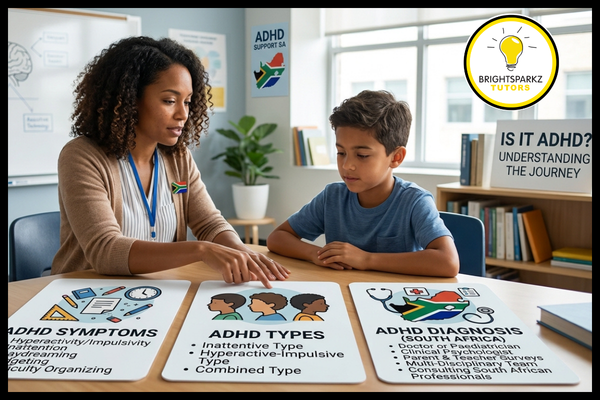
Understanding ADHD: A Parent's Guide to Symptoms, Types & Diagnosis

What Are the Symptoms of ADHD?

Here’s where it gets genuinely tricky: most young children get distracted, act on impulse, and struggle to sit still at some point. That’s normal childhood behaviour, not ADHD. Symptoms of ADHD usually appear early, often between ages 3 and 6, but because they overlap so heavily with ordinary development, they can be difficult to distinguish – which is exactly why a proper assessment matters rather than a checklist alone.

Symptoms generally fall into three categories:

1. Inattention – a learner may:

  • Be easily distracted, miss details, or frequently switch between tasks
  • Struggle to focus on one thing, especially something not immediately enjoyable
  • Have difficulty organising or completing tasks, or starting something new
  • Lose things needed for tasks (pencils, books, assignments)
  • Seem not to listen when spoken to directly
  • Process information more slowly than peers, or seem to daydream often
  • Struggle to follow multi-step instructions

2. Hyperactivity – a learner may:

  • Fidget, squirm, or struggle to stay seated
  • Talk excessively or seem constantly in motion
  • Have difficulty with quiet, still activities

3. Impulsivity – a learner may:

  • Struggle to wait their turn
  • Blurt out comments or act without considering consequences
  • Interrupt conversations or other people’s activities

Most children with ADHD show a mix of all three, though not always in equal measure – which is where the different types come in.

What Are the Different Types of ADHD?

Predominantly Hyperactive-Impulsive

Six or more hyperactivity/impulsivity symptoms present, with fewer inattentive symptoms (though some may still be there).

Predominantly Inattentive

Six or more inattentive symptoms present, with fewer hyperactive/impulsive symptoms. This is the type most likely to be missed. These learners often sit quietly and don’t act out, so they can look like they’re simply “not paying attention” or “a bit of a daydreamer” rather than showing signs of ADHD – and it’s part of why girls, in particular, tend to be diagnosed later than boys. You can read more about ADHD in girls here.

Combined Type

Six or more symptoms in both categories – this is the most common presentation.

Why ADHD Gets Missed

Because inattentive-type ADHD doesn’t come with disruptive behaviour, it’s easy for parents and teachers to overlook. A learner who’s quiet and well-behaved doesn’t tend to raise the same flags as one who’s visibly restless, even if they’re struggling just as much to keep up.

At the same time, hyperactive-impulsive symptoms are sometimes mistaken for a discipline issue rather than a barrier to learning, particularly in younger children where higher activity levels are developmentally normal.

Both patterns mean ADHD can go unrecognised for years, which is why paying attention to persistent patterns – not isolated moments – matters more than any single behaviour.

How Is ADHD Diagnosed?

There’s no single test for ADHD. Instead, diagnosis in South Africa typically involves a registered educational psychologist (or a paediatrician who may refer you to one), who will gather information about your child’s behaviour across different settings and over time.

The process usually involves ruling out other explanations first, such as:

  • Hearing or vision problems
  • Sleep issues or other medical conditions affecting behaviour
  • Anxiety, depression, or other conditions that can mimic ADHD symptoms
  • A recent major life change (a house move, loss in the family, parents’ divorce) that could be causing temporary behavioural shifts


From there, the psychologist will typically look at:

  • Whether behaviours are long-term and extreme, not just occasional
  • Whether they show up more than in peers of the same age
  • Whether they appear across multiple settings – home, school, social situations – rather than just one

This is usually gathered through observation, questionnaires completed by parents and teachers, and sometimes cognitive or academic assessments to check whether a learning difficulty is also present.

What Happens After a Diagnosis?

A diagnosis isn’t an endpoint – it’s the start of knowing what kind of support will actually help. Depending on your child’s needs, that might include:

  • Tailored academic support. One-on-one tutoring, paced and structured around how your child’s brain works best, rather than a one-size-fits-all classroom approach.
  • Exam accommodations. Many learners with ADHD qualify for support such as extra time or a prompter during assessments – worth discussing with your school. You can also find more information on our quick blog here.
  • A clearer picture of exam-time challenges specifically. Some learners manage well day-to-day but really struggle when assessment pressure hits – see our guide on why ADHD symptoms often intensify at exam time.

If you’re trying to work out whether what you’re seeing at home fits this picture, or you’ve already got a diagnosis and are wondering what support looks like in practice, BrightSparkz’s neurodivergent tutoring approach is a good next step to explore.

Why Does My Child’s ADHD Seem to Get Worse at Exam Time?

If your child manages reasonably well through the term – keeping up in class, getting homework done, coping day to day – and then everything seems to fall apart the moment exams or big assessments arrive, you’re probably not just imagining it. This is one of the most common patterns we see, and there’s a real explanation behind it.

ADHD during exam times

It’s Not That ADHD “Gets Worse” – It’s That Exams Demand Exactly What’s Hardest

ADHD doesn’t intensify overnight. What changes is the demand being placed on the parts of the brain ADHD affects most: planning, time management, working memory, and sustained focus under pressure – collectively known as executive function.

Day-to-day schoolwork is broken into smaller, structured chunks with regular check-ins from a teacher. Exams remove almost all of that structure at once: long stretches of independent, self-paced work, often across multiple subjects in a short window, with real stakes attached. For a learner whose executive function is already working harder than most just to keep up, that’s the exact combination that tends to expose the strain.

Why This Often Shows Up Specifically at Report Card and Prelim Time

A few patterns show up again and again around Term 2 report cards and Matric prelims in particular:

  • The gap between “knowing it” and “showing it” widens. Your child may understand the content perfectly when you go through it together, but freeze, blank, or run out of time the moment they’re sitting the actual assessment.
  • Studying itself becomes the obstacle. Revision requires self-directed planning – deciding what to study, when, and for how long – which is precisely the executive function skill ADHD makes hardest. It’s not unwillingness; it’s a genuine difficulty getting started and staying on track without external structure.
  • Time pressure amplifies everything. A learner who manages time reasonably well with support may completely lose track of pacing once they’re on their own in an exam venue.
  • Stress compounds the difficulty. Exam pressure adds an emotional-regulation load on top of an already-stretched attention system, which is part of why a capable learner can seem to “shut down” under pressure in a way that doesn’t match how they perform normally.

Is It ADHD, or Is It Just Exam Stress?

This is a fair question, and the honest answer is: it can be both, and they can worsen each other. Ordinary exam nerves are common in almost every learner. What tends to point specifically toward ADHD-related strain, rather than general stress, is a pattern where:

  • The struggle is disproportionate to how well your child understands the actual content
  • It happens consistently across assessments and subjects, not just one stressful test
  • It’s paired with the same difficulties you may see at other times – losing track of tasks, poor time estimation, trouble starting – just more visible under pressure

If you’re not sure which is driving what you’re seeing, that’s a reasonable thing to raise directly with a psychologist or your child’s tutor, rather than trying to work it out alone.

What Actually Helps at This Stage

The good news is that this pattern, while frustrating, is well understood – and there’s a lot that can help:

  • Structured, one-on-one support that breaks studying into manageable, externally-paced chunks – rather than expecting a learner to self-organise their own revision from scratch.
  • Practising under timed, exam-like conditions in advance, so the pressure itself becomes more familiar rather than something they’re facing cold for the first time.
  • Checking whether exam accommodations are appropriate – many learners with ADHD qualify for support like extra time or a prompter, which can meaningfully change how an exam actually plays out for them. See our guide on accommodations and concessions if this is new territory for you.
  • Tutoring specifically paced around how your child’s brain works, rather than a generic study plan. BrightSparkz’s neurodivergent tutoring approach is built around exactly this kind of individualised pacing.

You’re Not Overreacting

If report card season or prelims have you noticing a real dip that doesn’t match how capable you know your child to be, that instinct is worth listening to. This is one of the most common reasons families come to us for support in Term 2 and ahead of Matric finals – and it’s very fixable with the right structure in place.

Get in touch with BrightSparkz Tutors if you’d like help figuring out what kind of support would make the biggest difference for your child right now.

Understanding Dyscalculia – Part 3

Our two previous blogs discuss dyscalculia in detail. Now that we know a little bit more, what can we do to help our learners?

Tutor tips (For the tutor and the parents):

  • Use concrete examples that connect math to real life. For instance, use examples that include their favourite things or shopping. This helps to strengthen your learner’s number sense.
  • Use visual aids when solving problems. Draw pictures or move around physical objects. Teachers and tutors can refer to this as “manipulatives”
  • Assign manageable amounts of work so your tutee will not feel overloaded
  • Review a recently learned skill before moving on to a new one, and explain how the skills are related
  • Supervise work and encourage your learner to talk through the problem-solving process. This can help ensure your tutee is using the right math rules and formulas
  • Break new lessons into smaller parts that help to show how different skills relate to the new concept
  • Let your tutee use graph paper to help keep numbers lined up or in columns
  • Use an extra piece of paper to cover up most of what’s on a math test so your tutee can focus on one problem at a time
  • Playing math-related games helps your learner have fun and to feel more comfortable with math
    • Answer fewer questions on a test and allocate more time for your tutee to finish a test
    • Record lessons and lectures
    • Use a calculator in class
  • Boost confidence: Identify your tutee’s strengths and use them to work on (or around) weaknesses. Activities that tap into your tutees interests and abilities can help improve self-esteem and increase your learner’s resilience. Try to pace yourself during your tutoring sessions and do not use more than one strategy at a time. This makes it easier to tell which ones are producing a good result and which are not
  • Help your learner keep track of time: Whether it is a hand on the shoulder, a few key words or an alarm; have systems in place to remind your time-challenged tutee when to start the next activity.
  • See what it feels like: Try to experience what it is like to have dyscalculia. Acknowledging that you understand what your learner is going through is another way to boost his or her confidence and to improve your own level of understanding
  • Be upbeat: Let your tutee know when you see him or her do something well. Praising effort and genuine achievement can help your learner feel loved and supported. It can also give your tutee the confidence to work harder!
  • Support, patience and understanding are key!

To read more about being a great tutor, check out our Ultimate Guide on Tutoring!

If you would like a tutor to assist your child or learner, contact BrightSparkz Tutors today!


A version of this article has also been published on our sister-site.

Understanding Dyscalculia – Part 2

In our previous blog, an expansive amount of information was provided to help you (as a tutor or parent) to identify the symptoms of dyscalculia. Unfortunately, dyscalculia can affect other aspects of learner’s lives.

Other effects of dyscalculia

  • Social skills: Failing repeatedly in math class can cause your learner to assume failure is unavoidable in other areas too. Low self-esteem can affect your learner’s inclination to make new friends or to partake in after school activities. Some learners might also avoid playing games and sports that involve math and keeping score.
  • Sense of direction: Some learners might struggle to differentiate left from right and may have trouble getting places by reading maps or following directions. Some learners with dyscalculia cannot picture things in their minds.
  • Physical coordination: Dyscalculia can affect how the brain and eyes work together. Because of this, your learner may have problems judging distances between objects. Certain learners may seem clumsier than others the same age.
  • Money management: Dyscalculia can make it difficult to stick to a budget, to balance a checkbook, and to estimate costs. It can also make it hard to calculate a tip and count exact change.
  • Time management: Dyscalculia can affect your learner’s ability to measure quantities, including units of time. Learners may have trouble assessing how long a minute is or to keep track of how much time has passed. This can make it hard to stick to a schedule.
  • Other skills: A learner may have trouble figuring out how much of an ingredient to use in a recipe. Learners might have a hard time estimating how fast another car is moving or how far away it is.

Associated learning difficulties

  • Dyslexia, or difficulty reading
  • Attention difficulties
  • Spatial difficulties (not good at drawing, visualisation, remembering arrangements of objects, understanding time/direction)
  • Short term memory difficulties (the literature on the relation between these and dyscalculia is very controversial)
  • Poor coordination of movement (dyspraxia)

There is still so much we don’t know about dyscalculia, and no definitive cause has been found. However, there are some ideas that researchers are still studying.

Possible Causes

  • Genes and heredity: Studies show this more common in some families than others are. Researchers have found that a child with dyscalculia often has a parent or sibling with similar math issues. 
  • Brain development: Researchers are using modern brain imaging tools to study the brains of people with and without math issues. What we learn from this research will help us understand how to help learners with dyscalculia. Some studies have also found differences in the surface area, thickness and volume of parts of the brain. Those areas are linked to learning and memory, setting up and monitoring tasks and remembering math facts
  • Environment: Dyscalculia has been linked to contact with alcohol in the womb. Prematurity and low birth weight may also play a role in dyscalculia.
  • Brain injury: Some studies show that injury to certain parts of the brain can result in what researchers call “acquired dyscalculia.”

The most plausible cause for dyscalculia is due to a difference in brain function. Unfortunately, many people think that because it is in the brain, it cannot be changed but this is not true. There are many support systems and tutors available to help your leaner cope.

What Does This Mean?

The brain is a highly adaptable organ (most especially during childhood) and research has indicated that certain training programs can increase the functioning in brain areas involved with reading, and so researches are hopeful that the same is applicable for mathematics. It’s unclear how much of a child with dyscalculia’s brain differences are shaped by genetics, and how much are shaped by their experiences. Researchers are trying to learn if certain interventions for dyscalculia can “rewire” a learner’s brain to make math easier. 

What Do I Do?

If during your tutoring sessions, you suspect that your learner may be suffering from dyscalculia, it is your responsibility to keep record of your tutee’s difficulties. You then need to communicate your thoughts to your learner’s parents. The learner’s parents should discuss any concerns with the learner’s teachers who will ascribe a school therapist or specialist. The specialist will ask you, the tutor, the parents and the teachers various questions as well as chat to the learner to discern whether the learner does in fact have dyscalculia or perhaps a different learning disability.

To read more about being a great tutor, check out our Ultimate Guide on Tutoring!

If your learner does have dyscalculia, there are many things that you can implement and do during your tutoring sessions to help him or her with their studies and academic outlook. Our next blog will list important hints and helpful tips to use during your tutoring sessions (or as a parent)!

If you would like a tutor to assist your child or learner, contact BrightSparkz Tutors today!


A version of this article has also been published on our sister-site.

Understanding Dyscalculia – Part 1

Despite the fact that Dyscalculia affects around 6% of the general population, many learners, tutors and educators are unfamiliar with the specifics. The next few blogs will cover some important aspects of dyscalculia, what is entails, the symptoms, the diagnosing of dyscalculia, various effects, and more. I hope you find this helpful!

What is Dyscalculia?

Dyscalculia is a learning disability that affects one’s ability to do mathematics and to grasp mathematical concepts. Learners with dyscalculia struggle to learn mathematics and to develop mathematical skills despite an adequate learning environment at home and at school. There are different severities of dyscalculia and learners will react or adapt to each differently. Some learners might work hard to memorise simple number facts. Other learners may know what to do but not understand the reason behind certain mathematical methods or steps. This is likely because learners with dyscalculia are not able to see the logic behind mathematics. Learners with less severe dyscalculia might understand the logic behind maths but are unsure how and when to apply their knowledge when solving mathematical problems.

Dyscalculia affects people throughout their lifespan. Children with dyscalculia tend to begin falling behind from as early as primary school. Oftentimes, learners may develop a strong dislike for mathematics as a result. Once learners reach secondary school, they usually struggle to pass maths and science subjects.

Warning Signs of Dyscalculia

Dyscalculia comprises various types of mathematical difficulties. Your learner’s symptoms may not look exactly like those of another learner. Observing your learner and taking notes to share with teachers and doctors are good ways to find the most effective approaches and support for your learner. While the signs of dyscalculia look dissimilar at different ages, it does tend to become more apparent as kids get older but it can be detected as early as preschool. There is not sufficient research done on dyscalculia and so there is also no definitive list of symptoms and other than the obvious difficulty with mathematics, we know very little about what symptoms continue through to adolescence and adulthood. Because dyscalculia is best monitored and helped when spotted as early as possible, the following list has been comprised to help you identify any presently known symptoms:

Warning Signs in Preschool or Kindergarten

  • Has trouble learning to count, especially when it comes to assigning each object in a group a number
  • Has trouble recognizing number symbols, such as making the connection between “7” and the wordseven
  • Struggles to connect a number to a real-life situation, such as knowing that “3” can apply to any group that has three things in it; 3 cookies, 3 cars, 3 kids, etc.
  • Has trouble remembering numbers, skips numbers, or counts in the wrong order
  • Finds it hard to recognize patterns and to sort items by size, shape or colour
  • Avoids playing games that involve numbers, counting and other math concepts

Warning Signs in Grades 7 – 9

  • Has trouble distinguishing numbers from symbols
  • Has trouble learning and remembering basic math facts, such as 2 + 4 = 6
  • Struggles to identify mathematical signs (+-) and use them correctly
  • May continue to use fingers to count instead of using more sophisticated strategies
  • Has trouble writing numerals clearly or putting them in the correct column
  • Has trouble coming up with a plan to solve a math problem
  • Struggles to understand words related to math, such asgreater than and less than
  • Has trouble telling left from his right, and even a poor sense of direction
  • Has difficulty remembering phone numbers and game scores
  • Avoids playing games that involve number strategies
  • Has trouble telling time 

Warning Signs in High School

  • Struggles to apply math concepts to everyday life, including monetary matters such as estimating the total cost, making exact change and figuring out a tip
  • Has trouble measuring things such as ingredients in a simple recipe
  • Struggles finding his or her way around and worries about getting lost
  • Has a hard time grasping information shown on graphs or charts
  • Has trouble finding and using different approaches to the same math problem
  • Learners may lack assurance in activities that entail estimating speed and distance, such as playing sports and learning to drive

Symptoms of dyscalculia

  • Difficulty imagining a mental number line
  • Particular difficulty with subtraction
  • Difficulty using finger counting (slow, inaccurate, unable to immediately recognise finger configurations)
  • Trouble decomposing numbers (e.g. recognizing that 10 is made up of 4 and 6)
  • Difficulty understanding place value
  • Trouble learning and understanding reasoning methods and multi-step calculation procedures
  • Anxiety about or a negative attitude towards maths (caused by the dyscalculia)

Now that you are aware of the many and varied symptoms of dyscalculia, it will be easy for you as a tutor to spot any correlations or learning disabilities should your learner ever have. If, during your tutoring sessions, you notice your learner experiencing difficulty, it is important that you keep a record and then speak to his or her parents about your concerns.

The next blog will briefly list how dyscalculia is diagnosed and discuss various other effects of dyscalculia. If you have any further information or experiences, please write in and let us fellow tutors know!

If you would like a tutor to assist your child or learner, contact BrightSparkz Tutors today!

A version of this article has also been published on our sister-site.

Coping with and Helping Learners with ADHD

This blog recaps one of my previous about how to help learners with ADHD. This blog includes challenges posed for tutors and teachers who might have learners with ADHD as well as tips for tutors and learners who have ADHD.

ADHD can present the following challenges for tutors and teachers

  • Learners require more attention
  • Learners have trouble following instructions, especially when presented in a list
  • Learners often forget to write down homework assignments as well as completing given work
  • Learners may have trouble with operations that require ordered steps, such as long division
    or solving equations
  • Learners usually have problems with long-term projects where there is no direct supervision

To read more about being a great tutor, check out our Ultimate Guide on Tutoring!

ADHD can affect learners in the following ways

  • Low grades
  • Teasing from peers
  • Low self-esteem.

So what can we do to help and aid these learners with their studies?

Patience, creativity and consistency are three of the most important aspects to take into consideration when tutoring or teaching learners with ADHD. As a tutor or teacher, our job is to evaluate each individual learner’s needs and strengths. We then need to develop our lessons and strategies in accordance with this.

Additionally, one of the most effective ways of helping learners with ADHD is maintaining a positive attitude. Make the learner your partner and say, “Let’s figure out ways together to help you get your work done.” Reassure the learner that you will be looking for good behaviour and quality work. When you see it, support it with prompt and sincere acclaim. Finally, look for ways to motivate a learner by offering rewards (such as a longer break or less homework).

Tips for the Learner

  • Sit away from windows and doors so as to minimise distractions
  • Move while you work. Constantly moving can help you focus better on the task at hand
  • Concentrate on certain words! Studies show that repeating anchor words like “focus” can block distractions

Tips for the Tutor

  • Give instructions one at a time and repeat whenever necessary
  • Signal the start of a lesson with a cue and in opening the lesson, tell the learner what he or she is going to learn and what your expectations are
  • Tell students exactly what materials they’ll need
  • Where possible, work on the most difficult material first. This can help to make the most of your session/lesson
  • Colour-code sections of material and make use of visuals!
  • Test the learner in the way he or she does best, such as orally or filling in blanks
  • Divide long-term projects into sections and assign a completion date/goal for each
  • Allow the learner to do as much work as possible on a computer
  • Make sure the learner has a system for writing down assignments and important dates and uses it!
  • Establish eye contact
  • Vary the pace and include different kinds of activities. Many students with ADD do well
    with competitive games or other activities that are rapid and intense
  • Allow for frequent (but short) breaks
  • Summarise the key points before finishing the lesson
  • Lastly, and most importantly – be patient and understanding

At BrightSparkz Tutors we provide excellent one-on-one tutoring for Maths, Science, English, Afrikaans and more… Get a tutor today!  Visit www.brightsparkz.co.za for more information.

A version of this article has also been published on our sister-site

Is There a Secret to Raising Smart Kids?

A recent article by Carol S. Dweck suggests there may be! Her article, “The Secret to Raising Smart Kids” outlines the difference between two mind-sets, namely, a fixed mind-set and a growth mind-set. On the basis of extensive research and studies, she argues that a growth mind-set is the secret to being smart!

What is the growth mind-set? The growth mind-set focuses on “process” and hard work rather than on talent or intelligence. The growth mind-set places greater importance on learning through effort, hard work and overcoming challenges, and not running from them.

Many people assume that superior intelligence, capability or talent is the key to success. While this definitely helps, it is not necessarily the key, or the only key, to success. Research conducted over more than three decades shows that an overemphasis on intelligence or talent alone may cause feelings of vulnerability and a fear of challenges. Such feelings may stem from the notion that intelligence and talent are innate qualities and therefore pre-determine one’s capabilities and standards for learning and achieving. This is not true.

Tutors, parents and teachers can engender a growth mind-set in learners through praise for persistence, dedication, and hard work rather than for being clever. Simply telling a learner they are smart can instil a sense of laziness (or a fixed mind-set) because learners feel they are clever enough not to have to work or put in any effort. Such learners may thrive in earlier grades under the impression that not working while still maintaining good grades, means they are smart or gifted. Unfortunately, this ease seldom extends to higher grades and these learner’s results may later plummet. Rather than telling your learner how smart they are, praise them for their effort and what they did right. Tell learners success stories that emphasise and inspire hard work and an appreciation for learning.

Further research indicates that a growth mind-set better equips learners to deal with failure or bad grades. Learners who do not maintain a growth mind-set and have coasted by thinking they are too smart to make an effort, may attribute failure or a decline in grades to a lack of ability or intelligence rather than a simple lack of effort. Learners with a growth mind-set are more inclined to see a challenge or an issue as a problem to be solved instead of an obstacle they don’t have the capability or intelligence to overcome.

Tutors, teachers and parents should encourage learners to see the brain as a learning machine. If we see the brain as a machine that is constantly learning (which it is), then we are more likely to believe that we can expand our knowledge and skill-set through hard work and effort.

We at BrightSparkz Tutors agree that the brain is a learning machine and our tutors pride themselves on helping your learners to overcome any difficulty they may be experiencing through fun, dedication and enjoyment in learning!

If you want to learn more about the growth mind-set, visit http://www.scientificamerican.com/article/the-secret-to-raising-smart-kids1/ to view the entire article.

Tutor Tips: How to Sharpen Your Mind

Keeping the mind focused and attuned to what you are supposed to be focused on can be challenging! This is especially applicable for those of us who have busy schedules and who are in the middle of exams. Knowing the trivialities of distraction and procrastination; here is a list of ways to help you sharpen your mind.

  • Stay Active – Research shows that the more active you are; the better you are at retaining information and the less likely you are to suffer from memory loss as you get older. This doesn’t mean that you need to be at the gym every day. Instead, consider taking a daily walk or a different route to work or school in order to keep your mind and body active and engaged.
  • Break Things Up! – It is easier to memorize larger topics in parts. Once you are used to remembering smaller sections of information, you can start processing bigger chunks as you go along. This way you will get used to retaining more information each time.
  • Keep Things Organized – It’s difficult to remember things if your surroundings are disorganised. Take the time to organise your studies and study environment because the brain will then be able to sort what you study in a similar way as to how you organized it in the physical space
  • Visualize – Some studies suggest that it helps to visualize what it is you want to remember. The brain works by creating visuals of things. For example, when you read the word “dog” your brain doesn’t conjure up an image of the letters d-o-g, but rather the word invokes images of what a dog is. Rather than trying to get your brain to remember random symbols, attach the meaning of those symbols to visual cues and concepts that are easier to remember.
  • Use Associations – The brain works by building a large network of associations. That’s why there are certain words, phrases, and images that automatically make us link and remember certain things. If you want to remember someone’s name (especially in history), it’s good to build a memory association around it. That way all you have to do is remember the association, and the name should pop up along with it.
  • Use Mnemonics – This involves using phrases like Never Eat Silk Worms to remember the order of compass directions; N (North) E (East) S (SOUTH) and W (West). Mnemonics provide clues about what you’re trying to remember. If you have to remember a list of random items, it may be easier to establish a mnemonic in order to keep it organized and help you remember the first letter of each item on that list.
  • Rehearse and Rephrase – Rehearsing what you need to remember is a great way to commit it to memory. This will add repetition; and tutors, this is especially helpful for younger learners! Rephrase large sections of information into a short story or rhyme to help your learners remember information in a fun way.
  • Use Gestures – When you use or make gestures such as tapping, clapping, snapping, and others in conjunction with what you’re trying to remember, it commits this information to your muscle memory.
  • Say it Loud – Saying what you want to remember aloud helps you to remember things better and to recall it later. People have an aural memory when hearing what is spoken. This engages a different part of your brain, which can be beneficial to the process of recalling what it is you need.
  • Lastly, stay hydrated and feed your brain – Water, water, water! And remember the food you eat has a direct effect on your brain, which is why it’s essential to eat foods that contain the proper antioxidants for brain health.


Written by Kristin Naude of BrightSparkz Tutors – English and Maths Tutor