Understanding ADHD: A Parent’s Guide to Symptoms, Types & Diagnosis

If you’re here because something about your child’s behaviour has you wondering – a school report that doesn’t match how bright they seem at home, a teacher’s gentle suggestion, or a nagging feeling that things are harder for them than they should be – this guide is meant to help you make sense of what ADHD actually is, and what the process of finding out looks like.

What Is ADHD?

ADHD stands for Attention Deficit Hyperactivity Disorder. It’s one of the most common barriers to learning among school-aged children, affecting an estimated 5.3% of people worldwide. It’s not a matter of a child being “difficult” or not trying hard enough – it’s a recognised neurodevelopmental condition that affects how the brain manages attention, impulse control, and activity levels.

Because it’s so common, it’s worth every parent, tutor, and educator having a working understanding of what it looks like and how it’s identified – not to self-diagnose, but to know when it’s worth having a proper conversation with a professional.
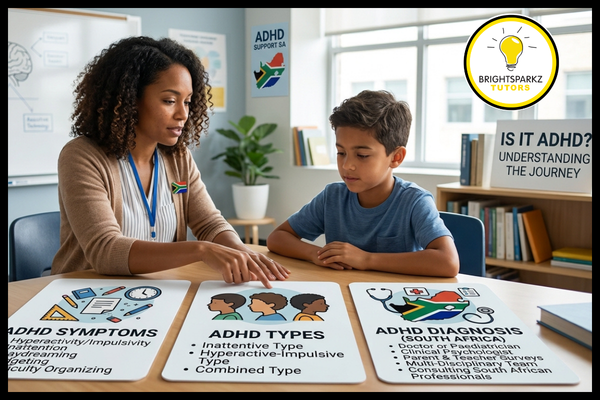
Understanding ADHD: A Parent's Guide to Symptoms, Types & Diagnosis

What Are the Symptoms of ADHD?

Here’s where it gets genuinely tricky: most young children get distracted, act on impulse, and struggle to sit still at some point. That’s normal childhood behaviour, not ADHD. Symptoms of ADHD usually appear early, often between ages 3 and 6, but because they overlap so heavily with ordinary development, they can be difficult to distinguish – which is exactly why a proper assessment matters rather than a checklist alone.

Symptoms generally fall into three categories:

1. Inattention – a learner may:

  • Be easily distracted, miss details, or frequently switch between tasks
  • Struggle to focus on one thing, especially something not immediately enjoyable
  • Have difficulty organising or completing tasks, or starting something new
  • Lose things needed for tasks (pencils, books, assignments)
  • Seem not to listen when spoken to directly
  • Process information more slowly than peers, or seem to daydream often
  • Struggle to follow multi-step instructions

2. Hyperactivity – a learner may:

  • Fidget, squirm, or struggle to stay seated
  • Talk excessively or seem constantly in motion
  • Have difficulty with quiet, still activities

3. Impulsivity – a learner may:

  • Struggle to wait their turn
  • Blurt out comments or act without considering consequences
  • Interrupt conversations or other people’s activities

Most children with ADHD show a mix of all three, though not always in equal measure – which is where the different types come in.

What Are the Different Types of ADHD?

Predominantly Hyperactive-Impulsive

Six or more hyperactivity/impulsivity symptoms present, with fewer inattentive symptoms (though some may still be there).

Predominantly Inattentive

Six or more inattentive symptoms present, with fewer hyperactive/impulsive symptoms. This is the type most likely to be missed. These learners often sit quietly and don’t act out, so they can look like they’re simply “not paying attention” or “a bit of a daydreamer” rather than showing signs of ADHD – and it’s part of why girls, in particular, tend to be diagnosed later than boys. You can read more about ADHD in girls here.

Combined Type

Six or more symptoms in both categories – this is the most common presentation.

Why ADHD Gets Missed

Because inattentive-type ADHD doesn’t come with disruptive behaviour, it’s easy for parents and teachers to overlook. A learner who’s quiet and well-behaved doesn’t tend to raise the same flags as one who’s visibly restless, even if they’re struggling just as much to keep up.

At the same time, hyperactive-impulsive symptoms are sometimes mistaken for a discipline issue rather than a barrier to learning, particularly in younger children where higher activity levels are developmentally normal.

Both patterns mean ADHD can go unrecognised for years, which is why paying attention to persistent patterns – not isolated moments – matters more than any single behaviour.

How Is ADHD Diagnosed?

There’s no single test for ADHD. Instead, diagnosis in South Africa typically involves a registered educational psychologist (or a paediatrician who may refer you to one), who will gather information about your child’s behaviour across different settings and over time.

The process usually involves ruling out other explanations first, such as:

  • Hearing or vision problems
  • Sleep issues or other medical conditions affecting behaviour
  • Anxiety, depression, or other conditions that can mimic ADHD symptoms
  • A recent major life change (a house move, loss in the family, parents’ divorce) that could be causing temporary behavioural shifts


From there, the psychologist will typically look at:

  • Whether behaviours are long-term and extreme, not just occasional
  • Whether they show up more than in peers of the same age
  • Whether they appear across multiple settings – home, school, social situations – rather than just one

This is usually gathered through observation, questionnaires completed by parents and teachers, and sometimes cognitive or academic assessments to check whether a learning difficulty is also present.

What Happens After a Diagnosis?

A diagnosis isn’t an endpoint – it’s the start of knowing what kind of support will actually help. Depending on your child’s needs, that might include:

  • Tailored academic support. One-on-one tutoring, paced and structured around how your child’s brain works best, rather than a one-size-fits-all classroom approach.
  • Exam accommodations. Many learners with ADHD qualify for support such as extra time or a prompter during assessments – worth discussing with your school. You can also find more information on our quick blog here.
  • A clearer picture of exam-time challenges specifically. Some learners manage well day-to-day but really struggle when assessment pressure hits – see our guide on why ADHD symptoms often intensify at exam time.

If you’re trying to work out whether what you’re seeing at home fits this picture, or you’ve already got a diagnosis and are wondering what support looks like in practice, BrightSparkz’s neurodivergent tutoring approach is a good next step to explore.

Why Does My Child’s ADHD Seem to Get Worse at Exam Time?

If your child manages reasonably well through the term – keeping up in class, getting homework done, coping day to day – and then everything seems to fall apart the moment exams or big assessments arrive, you’re probably not just imagining it. This is one of the most common patterns we see, and there’s a real explanation behind it.

ADHD during exam times

It’s Not That ADHD “Gets Worse” – It’s That Exams Demand Exactly What’s Hardest

ADHD doesn’t intensify overnight. What changes is the demand being placed on the parts of the brain ADHD affects most: planning, time management, working memory, and sustained focus under pressure – collectively known as executive function.

Day-to-day schoolwork is broken into smaller, structured chunks with regular check-ins from a teacher. Exams remove almost all of that structure at once: long stretches of independent, self-paced work, often across multiple subjects in a short window, with real stakes attached. For a learner whose executive function is already working harder than most just to keep up, that’s the exact combination that tends to expose the strain.

Why This Often Shows Up Specifically at Report Card and Prelim Time

A few patterns show up again and again around Term 2 report cards and Matric prelims in particular:

  • The gap between “knowing it” and “showing it” widens. Your child may understand the content perfectly when you go through it together, but freeze, blank, or run out of time the moment they’re sitting the actual assessment.
  • Studying itself becomes the obstacle. Revision requires self-directed planning – deciding what to study, when, and for how long – which is precisely the executive function skill ADHD makes hardest. It’s not unwillingness; it’s a genuine difficulty getting started and staying on track without external structure.
  • Time pressure amplifies everything. A learner who manages time reasonably well with support may completely lose track of pacing once they’re on their own in an exam venue.
  • Stress compounds the difficulty. Exam pressure adds an emotional-regulation load on top of an already-stretched attention system, which is part of why a capable learner can seem to “shut down” under pressure in a way that doesn’t match how they perform normally.

Is It ADHD, or Is It Just Exam Stress?

This is a fair question, and the honest answer is: it can be both, and they can worsen each other. Ordinary exam nerves are common in almost every learner. What tends to point specifically toward ADHD-related strain, rather than general stress, is a pattern where:

  • The struggle is disproportionate to how well your child understands the actual content
  • It happens consistently across assessments and subjects, not just one stressful test
  • It’s paired with the same difficulties you may see at other times – losing track of tasks, poor time estimation, trouble starting – just more visible under pressure

If you’re not sure which is driving what you’re seeing, that’s a reasonable thing to raise directly with a psychologist or your child’s tutor, rather than trying to work it out alone.

What Actually Helps at This Stage

The good news is that this pattern, while frustrating, is well understood – and there’s a lot that can help:

  • Structured, one-on-one support that breaks studying into manageable, externally-paced chunks – rather than expecting a learner to self-organise their own revision from scratch.
  • Practising under timed, exam-like conditions in advance, so the pressure itself becomes more familiar rather than something they’re facing cold for the first time.
  • Checking whether exam accommodations are appropriate – many learners with ADHD qualify for support like extra time or a prompter, which can meaningfully change how an exam actually plays out for them. See our guide on accommodations and concessions if this is new territory for you.
  • Tutoring specifically paced around how your child’s brain works, rather than a generic study plan. BrightSparkz’s neurodivergent tutoring approach is built around exactly this kind of individualised pacing.

You’re Not Overreacting

If report card season or prelims have you noticing a real dip that doesn’t match how capable you know your child to be, that instinct is worth listening to. This is one of the most common reasons families come to us for support in Term 2 and ahead of Matric finals – and it’s very fixable with the right structure in place.

Get in touch with BrightSparkz Tutors if you’d like help figuring out what kind of support would make the biggest difference for your child right now.

Tricks of the trade to mastering tutoring effectively

Tomorrow’s doctors, lawyers, scientists and artists are today’s children and to be able to nurture and nourish these young minds is an honourable privilege. Tutoring is a rare opportunity in having a positive impact on young individuals. It’s a special responsibility that should be carried out to the best of your ability. Here are a few tips to becoming a successful tutor:

1. Starting off on the right foot

When meeting learners for the first time it is important to develop a proper rapport. They need to feel comfortable enough to openly tell you where they require assistance. It is also essential to strike the right balance when it comes to making the learner comfortable and remaining rigid and in charge. The following may be helpful in your approach:

  • Making small talk in the beginning always breaks the ice. Always ask the learner about their day or any tests/ tasks they mentioned to you previously. By doing this it shows that you care and also pay attention to them.
  • As nice as it is to always play the good cop there comes a time where you have to make it clear to your student that you are not their friend but a mentor. The learner should not take advantage of your good nature. You are there to help them so if you have to put your foot down, do exactly that!

2. Problem areas

In addition to asking learners where their difficulties lie, also assess them as there may be problems that they, themselves, are not aware of. This does not necessarily have to be a specific topic but also simple tasks such as reading and writing. For example, a brilliant Maths student who fully understands his work, falls short due to hastily reading questions and misinterpreting them. These problem areas should be the focus of your tutoring sessions.

3. Tutoring each student is unique

Do not use the same method or style for all your learners. Always assess your learner on your first lesson, whether it’s required or not. It will give you a better indication of what would work for the learner. Pick an approach, test it out, if the learner doesn’t respond well, change your approach. Do not force your teaching style on the learner. Have an open mind and always keep the learner’s best interest in mind.

4. Scheduling

A lot of learners will not listen and plan their time table on their own. Instead of explaining how to, take a few minutes to help them actually plan it out. If you tell a learner to plan it out themselves, they view it as extra work. Let’s face it, no learner wants to do more work than they have to.  Plan a schedule with them and motivate them to stick to it. You can also lead by example by implementing this in structuring your lessons. If you stick to a schedule they will follow suit.

For example, in a 1 hour lesson:

  • 10 mins is dedicated to a quick revision test.
  • 40 mins allocated to discussing the topic of choice
  • 10 mins to homework collection and handing out new homework.

5. Challenge your learner

Continuously test pupils on previous work as well as areas they comfortable with to keep the content fresh in their minds. Learners tend to zone out sometimes, by continuously questioning them and keeping them on their toes, you are forcing them to pay careful attention to you. It is also a good way to detect which topics need more work on and is also great preparation for spot tests at school.

6. Feedback to parents

It’s vital to keep parents updated so that they can also step in when the need arises. Tutors usually put all their attention on the learners and forget about the parent’s role in all of this. Parents are naturally concerned about their children, reassurance from you will take a weight of their shoulders. They are entrusting you with their child’s future, so the least you can do is keep them in the loop. Express your concerns and approach with them, sometimes they can help enforce certain rules or behaviours that would be beneficial for the student.

tutoring

Tutoring is more than just passing down knowledge, you are playing the role of not only a teacher but also a role model. Every student is not going to be obedient and easy to work with, you are going to come across a few who push your buttons and make you question what you do. When that time comes, remember that you have the ability to shape the student into a better human being. It is a major responsibility so always give it your 100%, never give up, and remember the difference you making in their lives.

If you want to become a BrightSparkz tutor, find out more here. 

Written by Nirvana Rampershad, BrightSparkz Tutor & Guest Blogger

I’m sharing a package with another tutor – what does that mean?

If you’re sharing a package with another tutor, you need to be aware of 3 important things:

  1. Both you and the other tutor(s) can log lessons on the package – so you need to check that there is an available lesson on the package before every lesson. A double lesson or lessons on a few days in a row with the other tutor will quickly use up any remaining lessons. Making sure you keep your shared lesson logsheet up to date will also help with this.
  2. The package will not necessarily be split equally between the tutors! The client will decide how to split the lessons based on what the student needs. Please do not assume the number of lessons that you will be conducting on a certain package.
  3. You will not be conducting the lessons with another tutor. You will be responsible for arranging lesson times for the subject(s) that you are tutoring, and the other tutor(s) will be responsible for arranging lessons for their subject(s).

For example, Jackie purchases a 10 x 1 hour lesson package for her son, to be split between 3 tutors – for Maths, Natural Science and English. This DOES NOT mean that each tutor will conduct 3.33 lessons! If Jackie’s son is struggling more with Maths and Natural Science, but just needs 1-2 lessons to recap his English, the lesson split might be: 4 lessons for Maths, 4 lessons for Natural Science, and 2 lessons for English. 

All you need to know about the logsheet!

A logsheet is extremely important – it is the proof that you were at a lesson. It is vital that you have one logsheet per package, per client. If a client disputes a lesson i.e. says you were not there or that the lesson was cut short, you can provide the logsheet as proof. If there is an adult around, they should always sign the logsheet, if not, the learner can sign as well. 
 
Please remember to take a photo of the logsheet after each lesson, in case you need to send it to us, and you’re not able to see the client to get the physical copy.
 
So, do I need to send my logsheet or a photo thereof to BrightSparkz at the end of each month, in order to be paid?
 
No, you do not. All you need to do is keep the logsheet, or a photo thereof, in a safe place in case of any disputes, and log and submit your lessons online (see our FAQs about payments and logging & submitting lessons).

Where do I find resources?

When you are first assigned a client, you’ll be sent a First Lesson Pack, containing all the admin resources that you’ll need for your lessons going forward. In addition, you’ll be sent a link to the BrightSparkz Resources site, which has the CAPS curricula, tests and worksheets on it, as well as additional links to other sites containing good resources. If you’re STILL struggling to find resources, you can get in touch with your BrightSparkz Client Consultant, and we’ll be happy to point you in the right direction :) You’re welcome to use any age-appropriate resources in your lessons, including books, videos and even games – get creative!

How do I update my banking details?

For first time tutors, please update your banking details on your tutor profile, on the portal. There is a tab for this.

If you have changed banks (e.g. ABSA to FNB) or bank accounts (e.g. cheque to savings), please update this on the tutor portal AND then send us an email (not via whatsapp), that your banking details have changed, and that the portal has been updated accordingly. If you do not do this, we will continue to make payments into your old account and it will be your responsibility to sort it out with the banks.

How should I communicate with BrightSparkz? (Etiquette)

Please make sure that you communicate with us on a professional level – we are your employers. Please always remember your manners – “hi” / “bye” / “please” / “thank you”!

Urgent things related to your lesson on the day/during that week: Please WhatsApp us and then call if you have not had a response within 30 minutes or even sooner if extremely urgent! Don’t be afraid to call us!

Payment related: Please send us an email to queries@brightsparkz.co.za. If you do not email us, your query will not be attended to.

How should I communicate with clients? (Etiquette)

Please make sure that you communicate with your client on a professional level – they are also partly your employers.

Address the parent / guardian as Mr/Mrs (surname). If the client asks you to call them by their name, you’re welcome to do so.

If the client takes a more relaxed approach, please respond in kind, but still keep it professional.
Please always remember your manners – “hi” / “bye” / “please” / “thank you”!